Judith Neunhäuserer
∗1990, Italy
Judith Neunhäuserer (1990, Bruneck–Brunico, Italy) lives and works between Munich and Milan. Her multimedia practice is informed by the cultural study of religion, through which she observes worldmaking in the sciences. She works on the interpenetration of disenchantment and scientific mythology, historical and contemporary symbol systems, insightful dreams and holistic models. A key question regards the understanding of “nature”, which always defines the human position in the respective cosmology as well.Neunhäuserer has taken part in artist residencies in major urban centers such as London, Paris, and Gwangju, and has joined scientific expeditions to Antarctica, Svalbard, and across the Atlantic. She is now turning to stories from the Alpine region, where she comes from. Her artistic research, which primarily materializes in sculptural, installation, or video form, is accompanied by lectures and publications.
On the one hand, Judith Neunhäuserer uses durable materials like stone, metal and glass, presenting them as embedded within relational fields of constant transformation. On the other hand, the text-based dimension of her work engagages with academic traditions of knowledge production; by foregrounding their metaphorical and fragmented character, she challenges the authority of archives, highlights the politics of science, and calls for responsability in research.
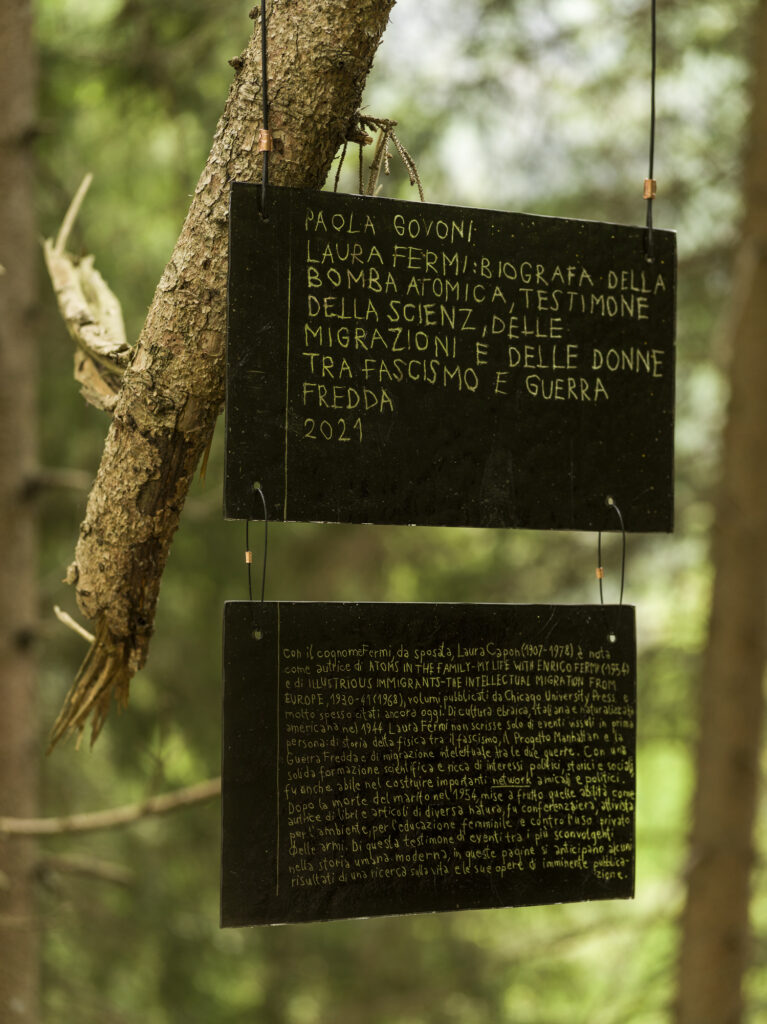
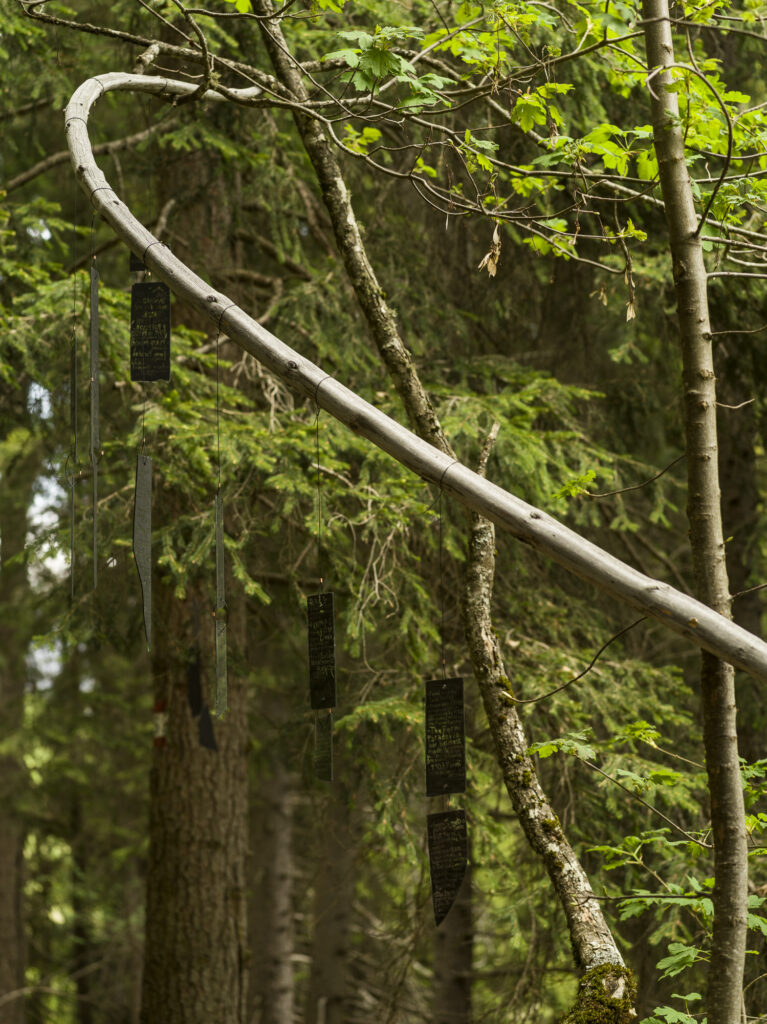
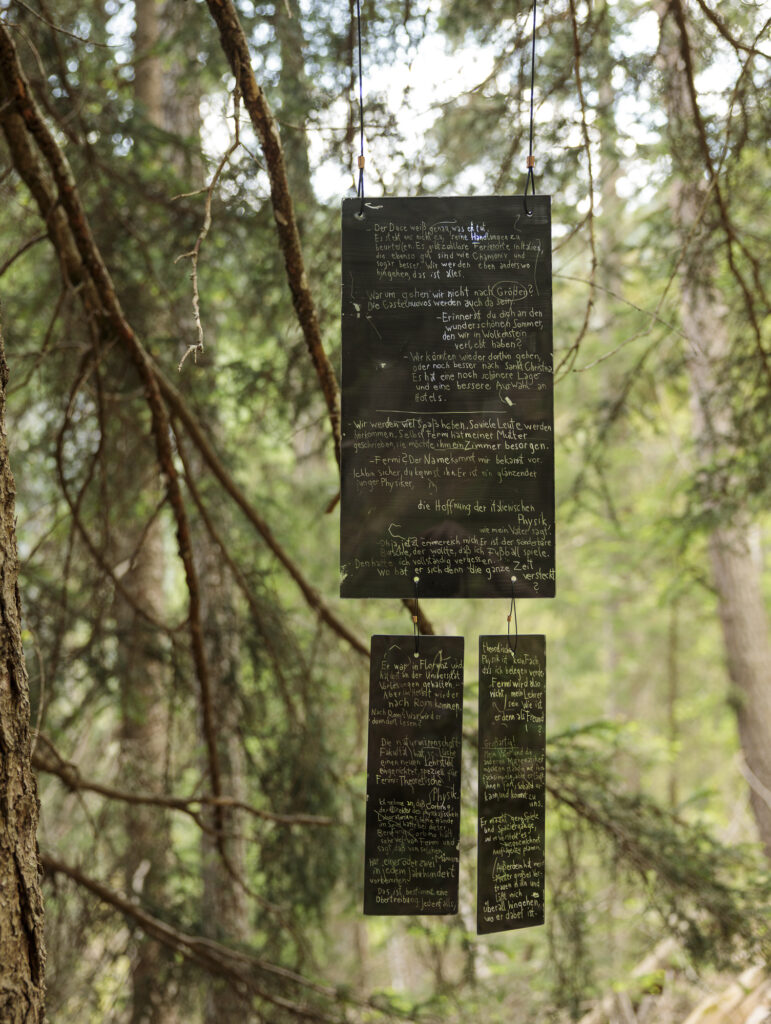
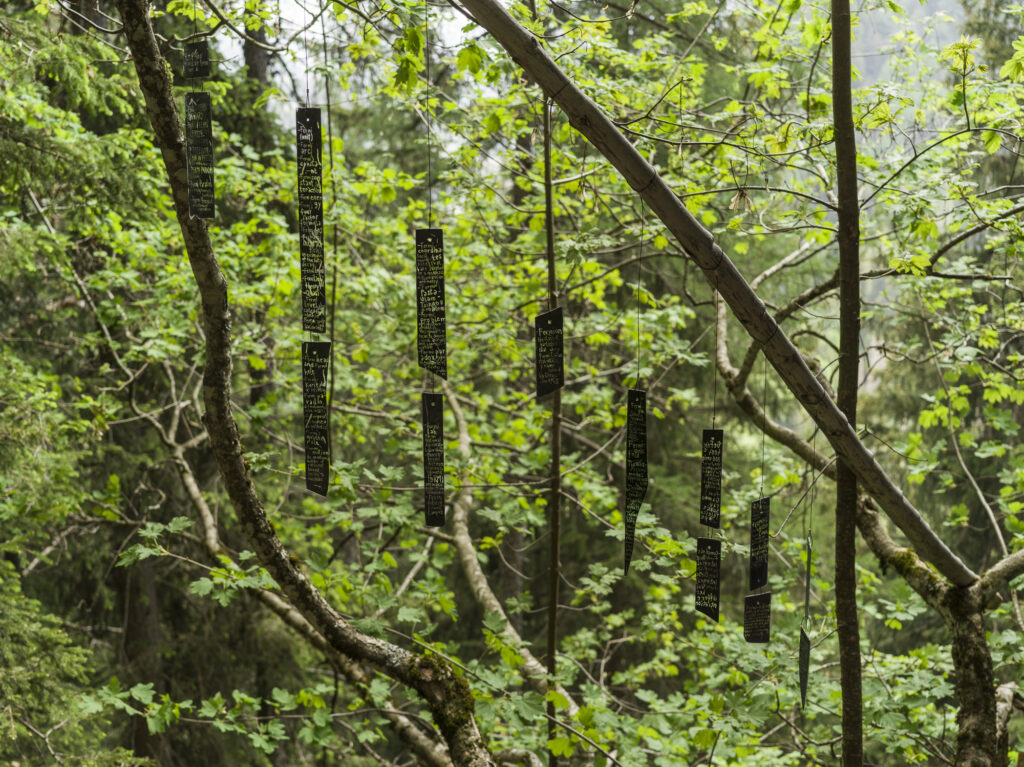
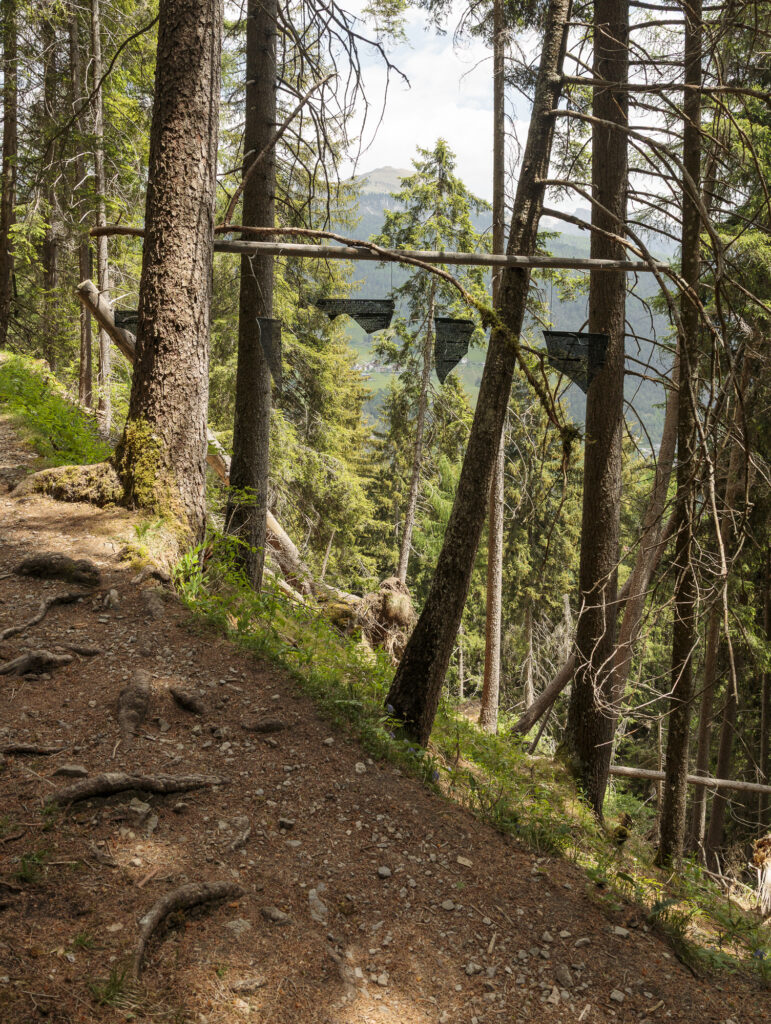
Extending along the trail nr. 15 to Pilat, Neunhäuserer presents a dispersed installation of over 200 suspended glass elements. An incomplete collection hangs from trees, inviting discovery. The fragments form a subtle, elusive presence, gradually emerging as interruptions within the forest. Each shard is coated and inscribed through removal: scratched texts and drawings become transparent, their visibility shifting with light, weather, and density of the background. Language and information appear as absence, requiring active perception.
The work references Laura and Enrico Fermi, who spent the summer of 1926 in Val Gardena, and whose later roles in nuclear history cast an ambivalent shadow. Drawing on Laura’s writings, Neunhäuserer interweaves personal narrative, scientific discourse, and ethical questions in wartime. Imagery of nuclear fission, radiation, and Hiroshima’s mushroom cloud contrasts with the notion of the forest as sanctuary. The installation proposes a “violent garden,” where knowledge, power, and consequence converge,and refuge is unsettled.
With the support of Stiftung Kunstfonds, Beauftragten der Bundesregierung für Kultur und Medien, VG Bild-Kunst | Thanks to the Prugger Family, Piz, Janek, Paola Govoni, Kirsten Zeitz, Neringa Vasiliauskaite, Matteo Pizzolant
Has taken part in: